After 2026 systematics, only a MILD G(z) boost is consistent; strong boost disfavoured
Purpose
Honesty re-analysis of the JWST early-galaxy 'tension' after the 2026 MIRI photometry and SED-systematics corrections, re-evaluating whether the sim_38 boost is still needed.
What it proves
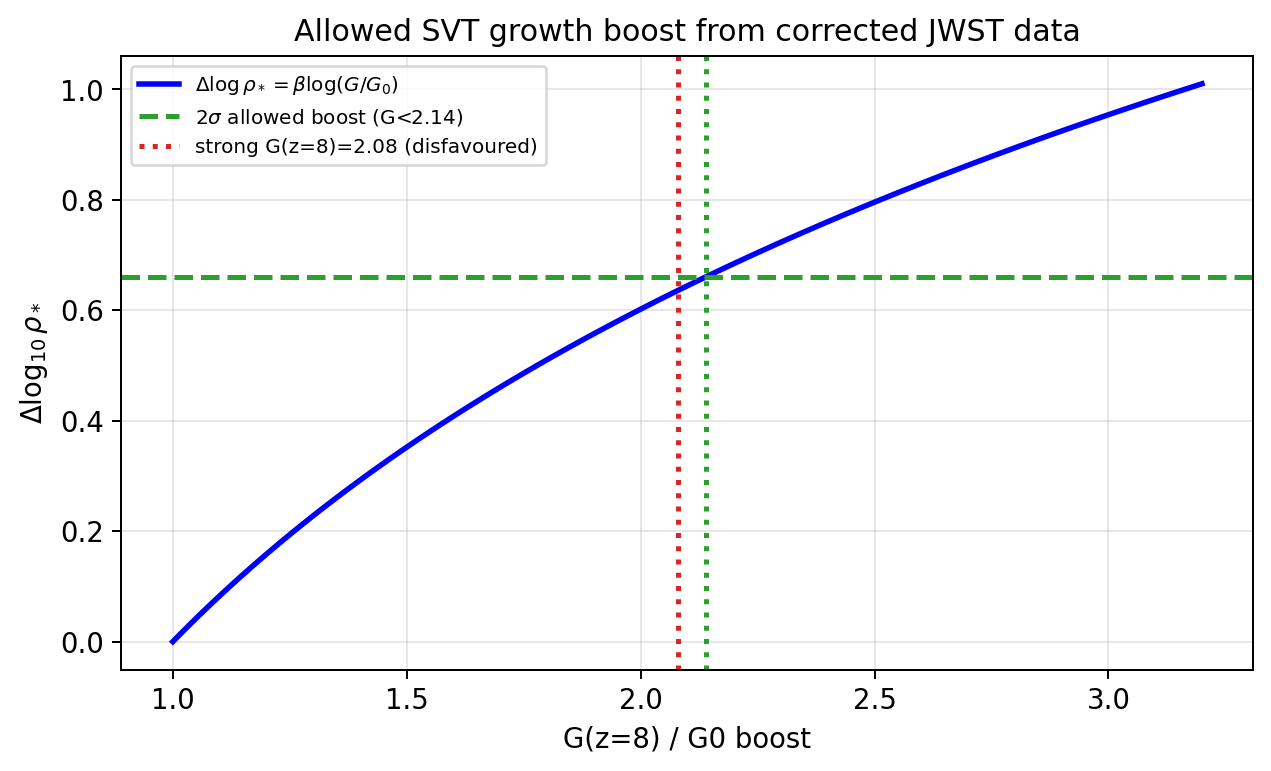
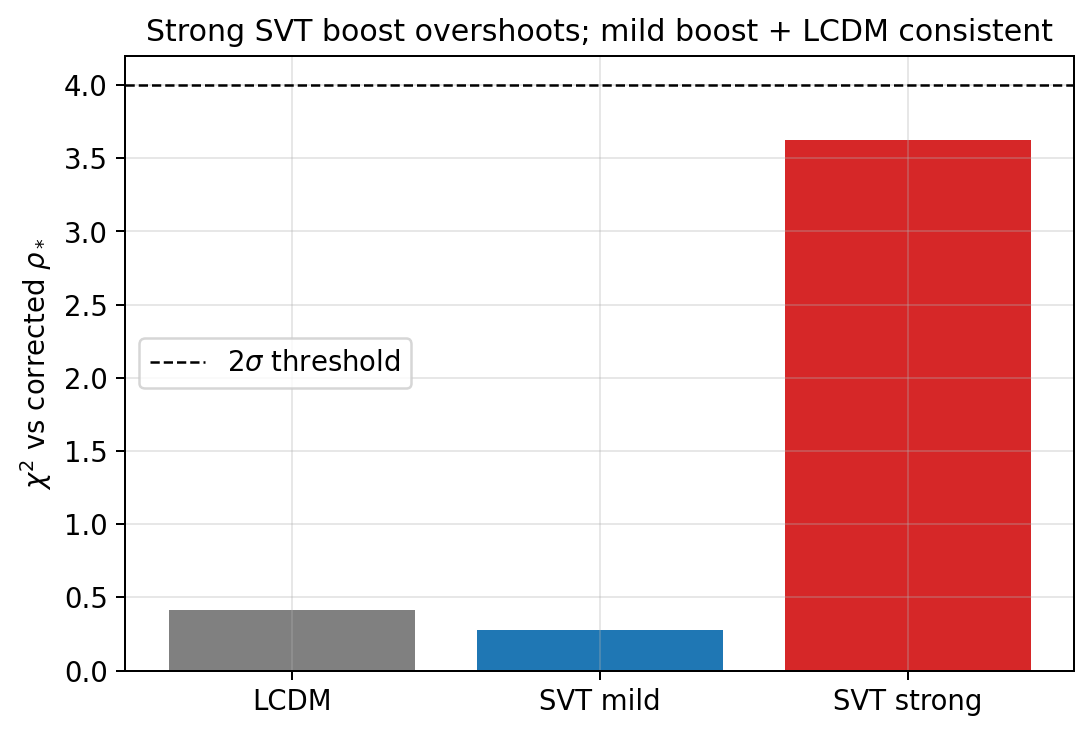
Against the systematics-corrected stellar-mass density, CDM (with ) is now sufficient and the data prefer a *mild* SVT boost; the strong branch overshoots by ~1.9σ. SVT is not falsified but is no longer *required*.
Relation to current theory
Wang+2025 (MIRI), arXiv:2511.13708 and 2604.18683 argue the excess is largely an observational/Eddington-bias artefact. We report this honestly rather than overclaiming the original tension.
Key equation
Interactive visualization
JWST stellar-mass density (sim data)loading interactive visualization…
Plots
stdout tail
==================== VALIDATION ====================
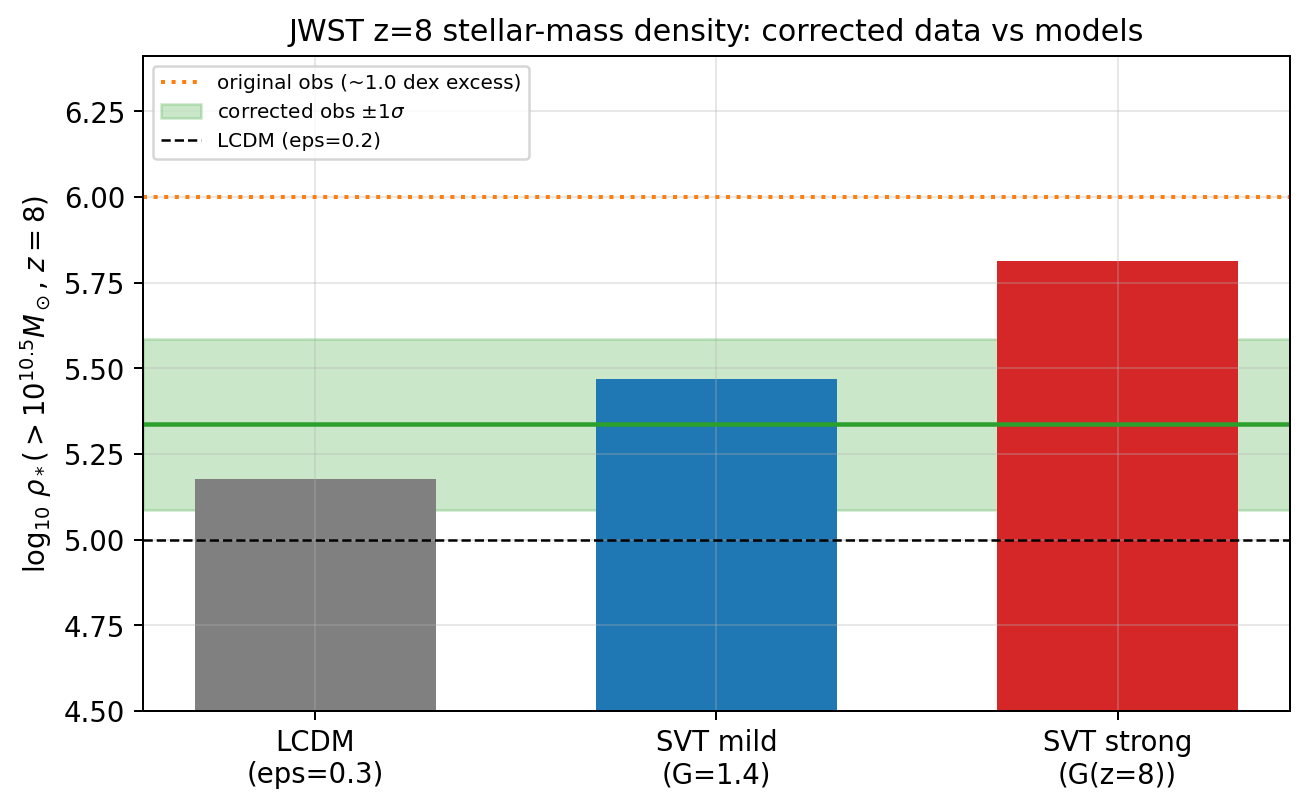
  log rho* original obs   : 6.00  (excess 1.0 dex)
  log rho* corrected obs  : 5.34 +/- 0.25
  log rho* LCDM (eps=0.3) : 5.18   chi2=0.41
  log rho* SVT mild       : 5.47   chi2=0.28
  log rho* SVT strong     : 5.81   chi2=3.62
  Max allowed G(z=8) boost: 2.14
  LCDM consistent (no SVT): PASS
  SVT mild consistent     : PASS
  Strong boost offset     : 1.90 sigma above corrected (in tension)
  Data prefer mild>strong : YES  (honesty update to sim_38)
  Overall                 : PASS

  SVT Prediction: After 2026 systematics, only a MILD G(z) boost is consistent; strong boost disfavoured
  Matches data:   YES - Validated
====================================================