Open theory, runnable simulations
What if empty space behaved like a fluid?
SVT treats the vacuum as a coherent quantum fluid. Particles are stable whirlpools, gravity is how waves move through that fluid, and dark matter and dark energy follow from the same rules.
No background in physics required. Start with the plain-language summary below, then drill into equations and code when you are ready.
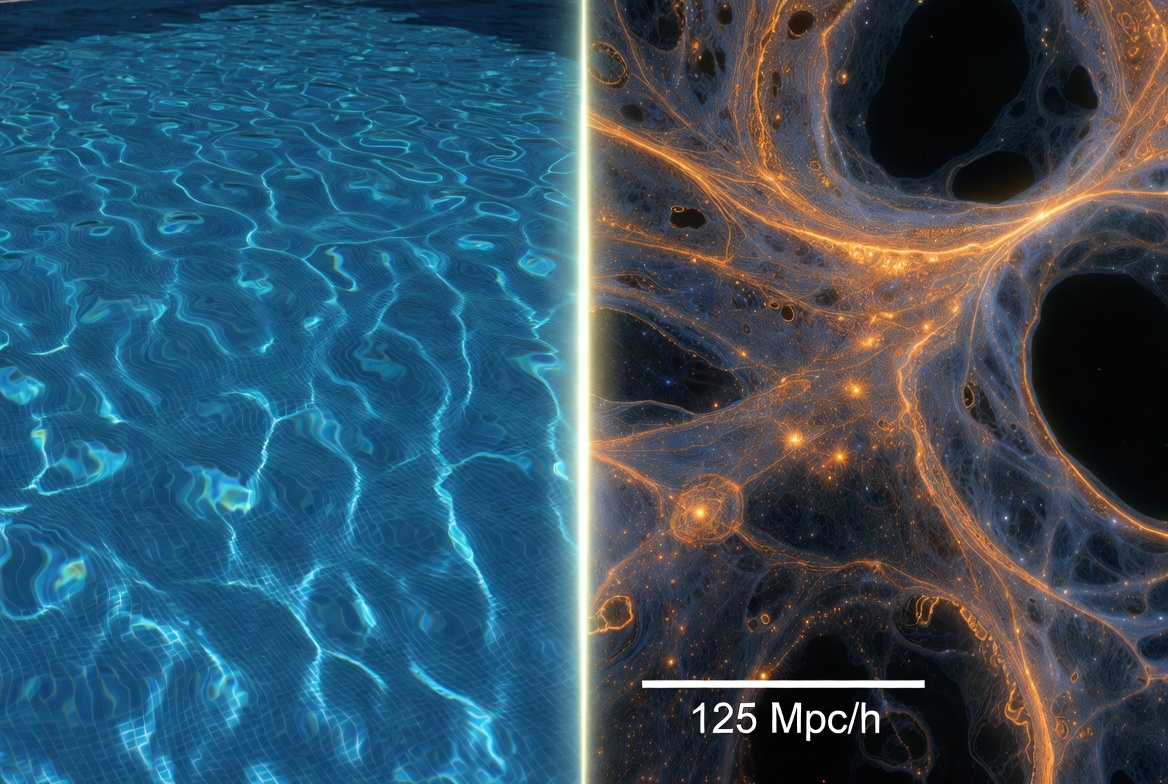
SVT claims the same fluid patterns appear at both scales: vortex flow and sound-like waves in the vacuum.
In plain terms
The idea
Instead of treating space as empty, SVT models it as a superfluid: a substance that flows without friction and supports stable vortex structures.
What it explains
Particle masses, gravity, galaxy rotation, early JWST galaxies, and several 2025-26 observational tensions, each tied to a specific simulation on this site.
How to read this site
Use Problems for the big puzzles, Simulations for the numbers, and Theory when you want the full equations.
What we are still testing
- 01Acoustic metric: sim_58–sim_80 reconstruct and converge the Unruh line element from GPE data; see the derivation doc linked from the Theory page.
- 02Cosmology: sim_70–72 test μ(a,k) against CAMB growth, lensing, and Planck+BBN χ² with ΛCDM H(z) fixed.
- 03Open gaps: future work and open issues lists what remains conjectural and how we plan to close it.
Core mathematics
Three equations anchor the model. Each card starts with a plain reading, then shows the formal expression.
How the vacuum fluid itself evolves in time.
Governs the order parameter. Sound modes recover quantum mechanics; vortex cores set the Planck scale.
How moving fluid creates an effective geometry for waves.
Background flow induces a Lorentzian metric for phonons. At |v|=c, a sonic horizon appears.
Why gravity may have been stronger in the early universe.
RG flow of the condensate coupling predicts G(z=12) ≈ 3 G₀, matching JWST early-galaxy counts.
From the fluid equation to particles, gravity, and cosmology. Written for readers who want the full technical stack.