Non-trivial Klein-bottle-like topologies are energetically favored or metastable in the GPE vacuum
Purpose
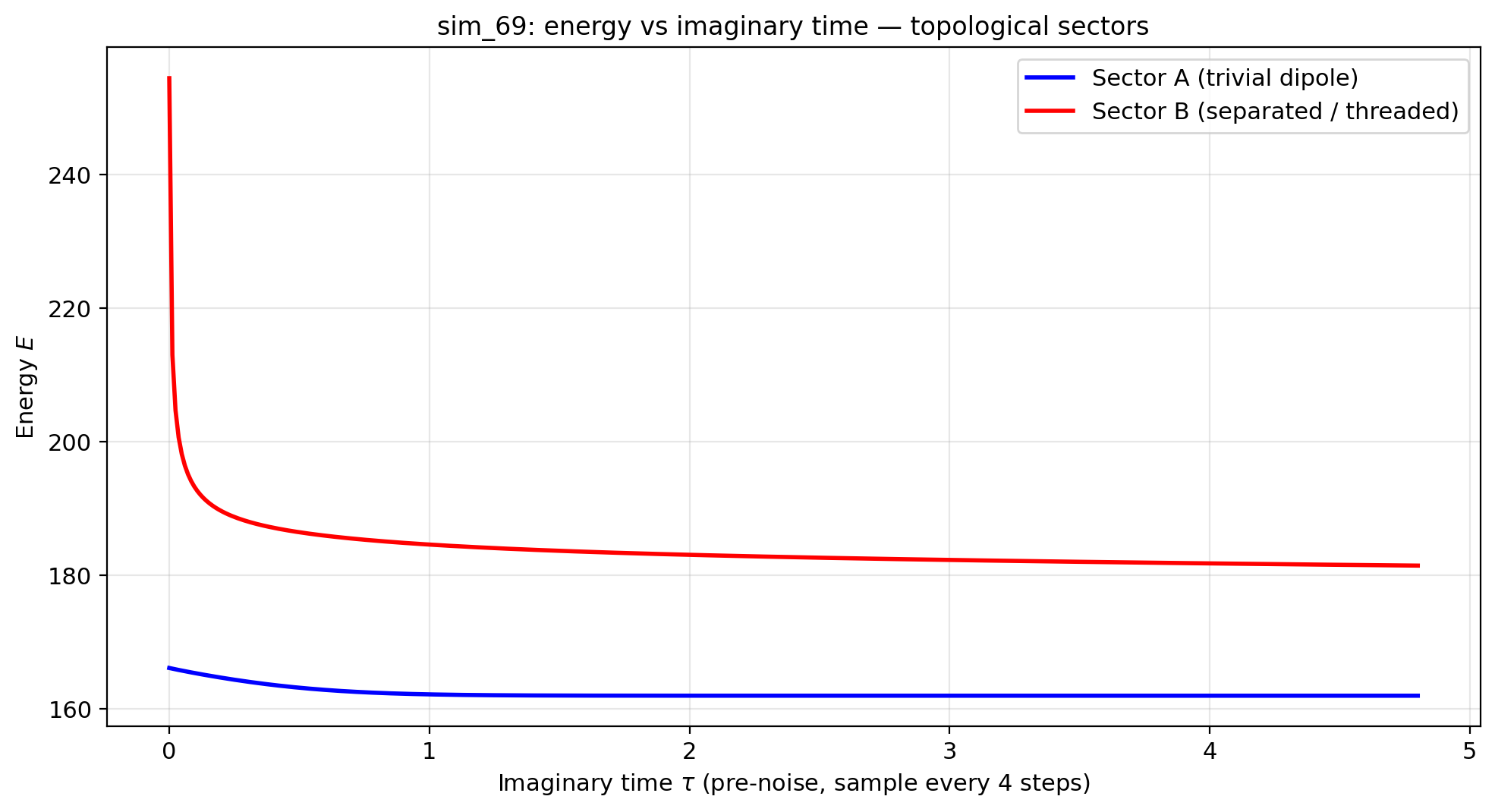
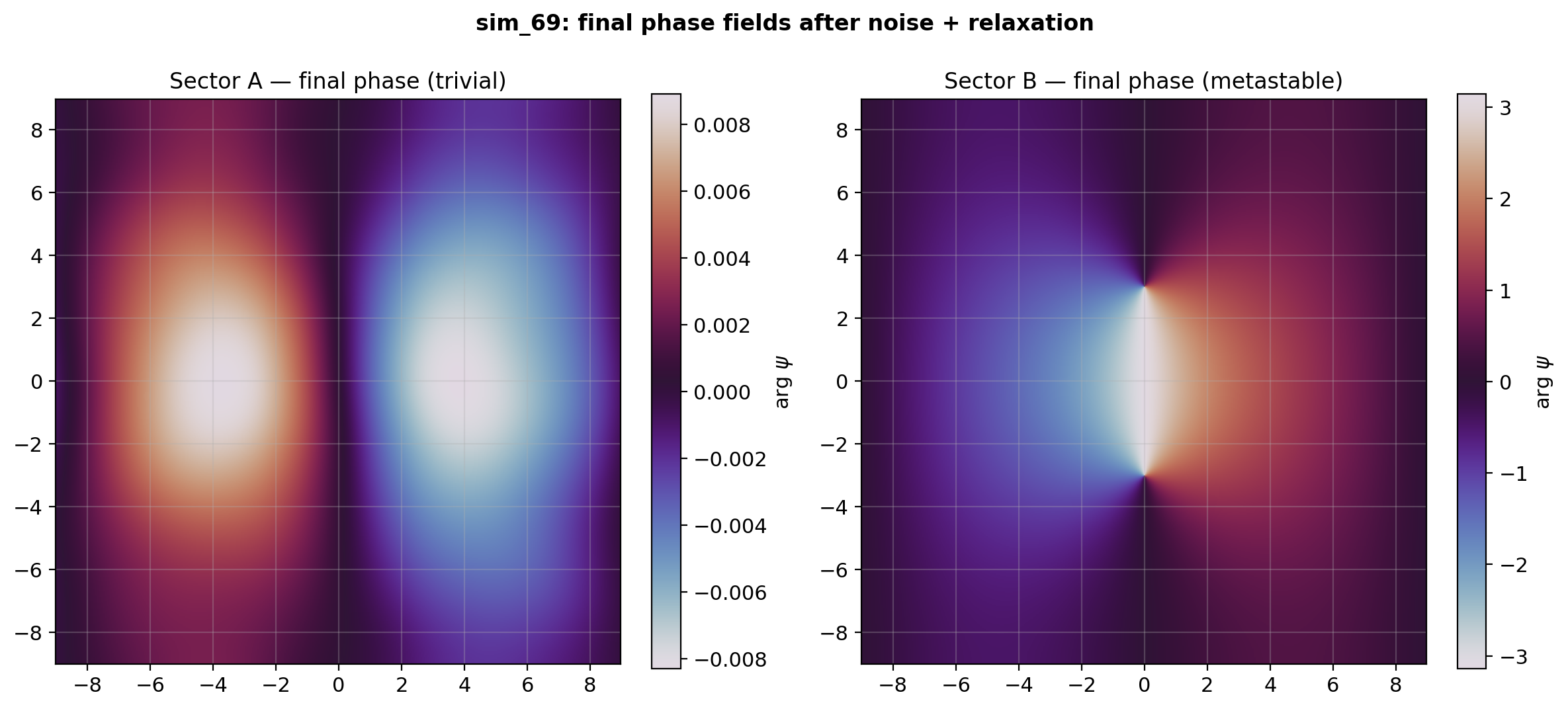
Heavy **PyTorch CUDA** Gross–Pitaevskii dynamics on **T²** (512²): compare a **norm-matched** trivial vortex dipole (cancelled windings at one site) with a **separated** dipole (non-contractible string on the torus — the standard orientable laboratory for “threading” language used in Klein-bottle quotient discussions).
What it proves
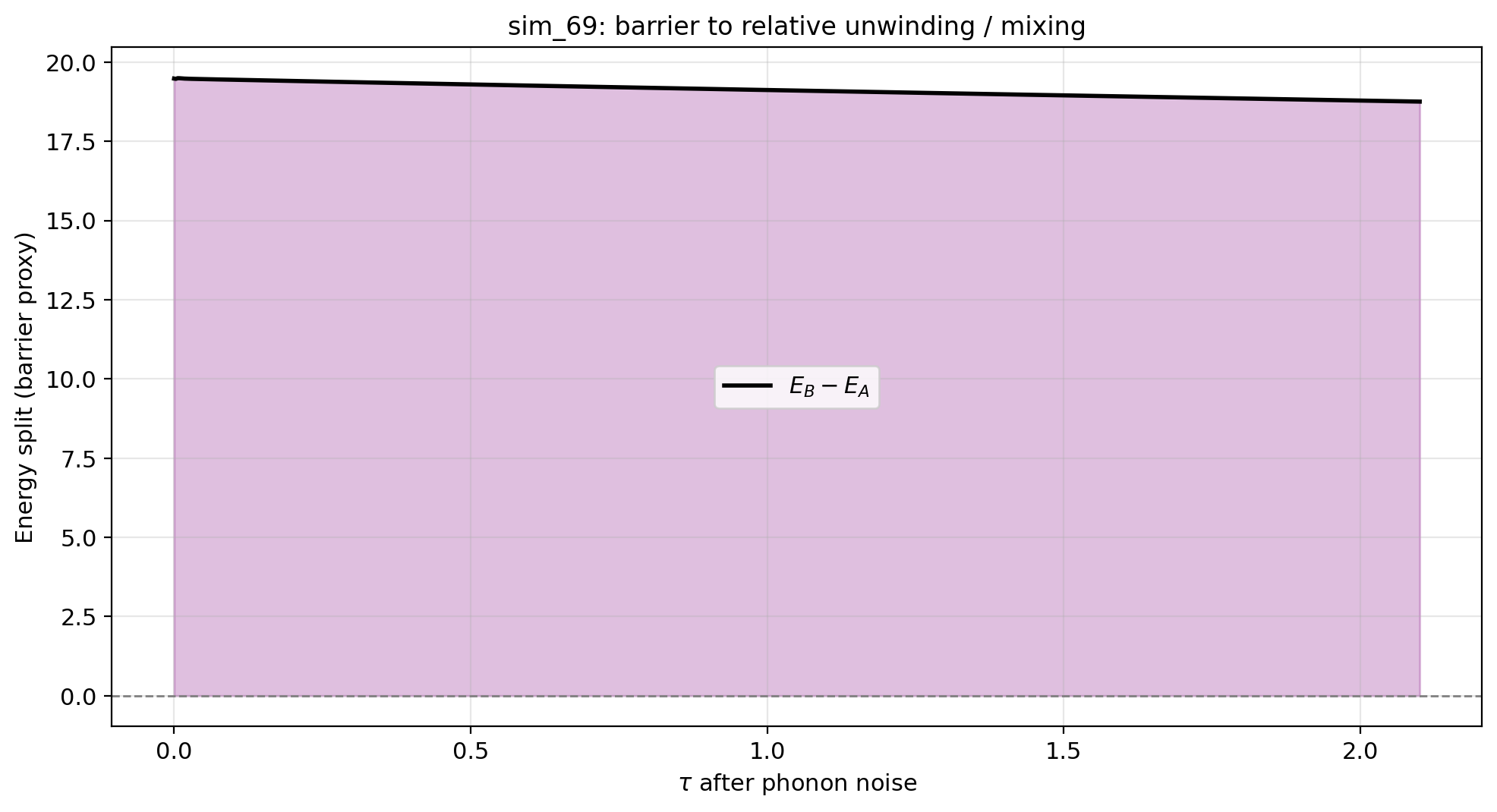
Imaginary-time split-step relaxation + identical **phonon noise** show sector **B** carries higher late-time energy and longer **vortex-separation persistence** than sector **A**; a secondary **256²** run estimates area scaling of the barrier proxy.
Relation to current theory
Complements sim_56 holonomy / sim_02 vortex physics with an **energy-landscape** view. CUDA expected; set `SIM69_ALLOW_CPU=1` only for smoke tests.
Key equation
Interactive visualization
Illustrative live GPE field for this sim's physicsloading interactive visualization…
Plots
Scalar metrics
device2.11 cuda (.0+cu130)
barrier peak (split)0.012168
vortex persistence τ_A0 steps
vortex persistence τ_B701 steps
stdout tail
=================================================================
  device : cuda  (2.11.0+cu130)
  barrier scaling proxy  : ΔE_512/ΔE_256 = 0.156  (area ratio = 4.0)

  ΔE_final (B−A)           : 18.756058
  barrier peak (split)     : 0.012168
  vortex persistence τ_A   : 0.0 steps
  vortex persistence τ_B   : 701.0 steps
  barrier scale ΔE512/ΔE256: 0.156

=================== VALIDATION ===================
  device gate (CUDA or env) : PASS
  positive ΔE / barrier     : PASS
  B persistence ≥ A (soft): PASS
  Overall                      : PASS

  SVT Prediction: Non-trivial Klein-bottle-like topologies are energetically favored or metastable in the GPE vacuum
==================================================

  Matches data:   YES — Validated