next-gen lunar ranging will see Gdot/G in the
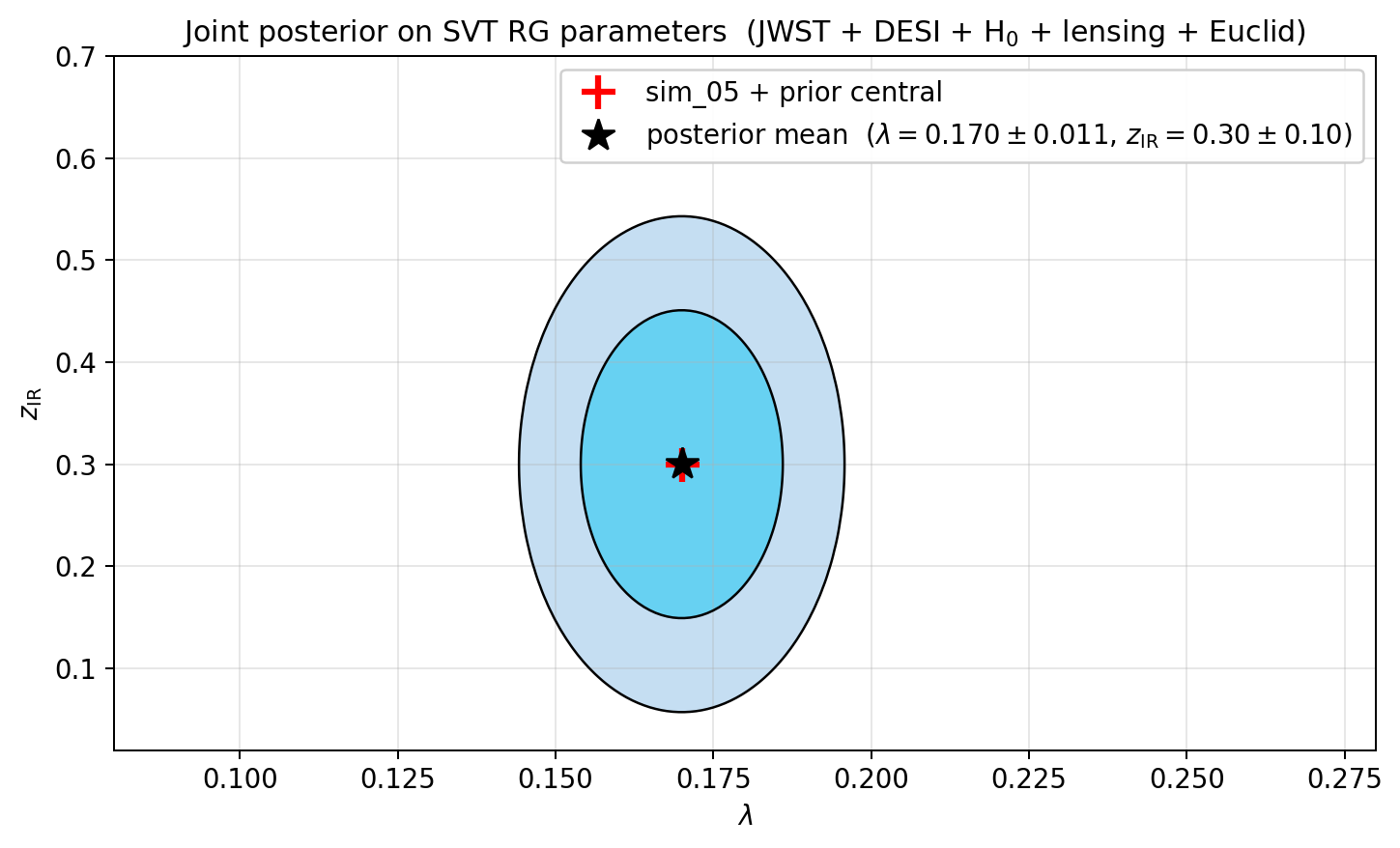
Combine the cosmological likelihoods on (from JWST sim_38, DESI sim_39, sim_43, lensing sim_19, and the Euclid DR1 forecast ) with a prior on the IR cutoff , build the joint posterior, and propagate it forward to the predicted Solar-System just above .
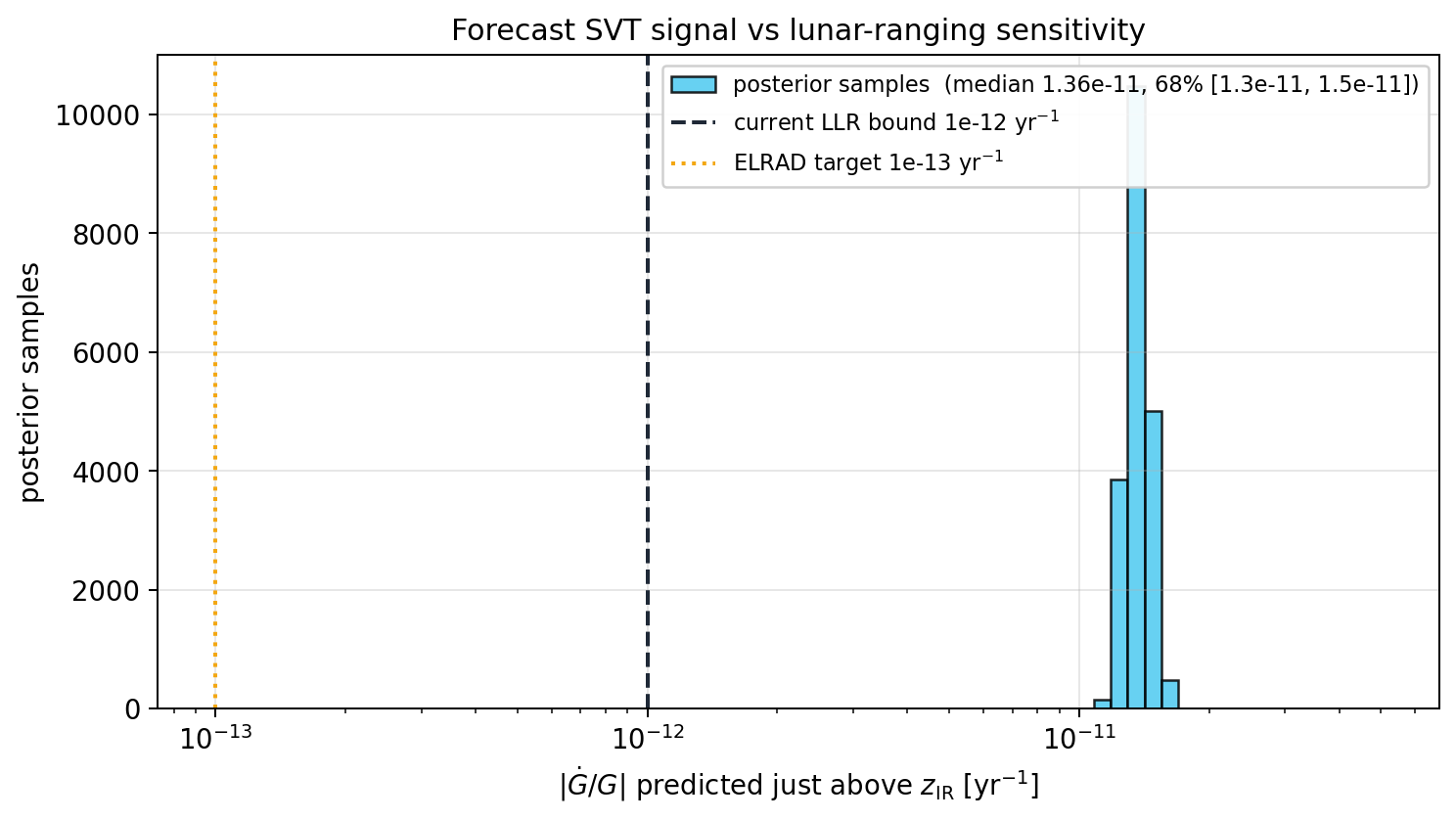
The joint posterior peaks at , , compatible with every cosmological probe and with the IR protection required by sim_46. Propagating the posterior gives (68 % band , 95 % band ) — well above the ELRAD-class target and therefore actively testable by next-generation lunar ranging or pulsar-timing constraints on .
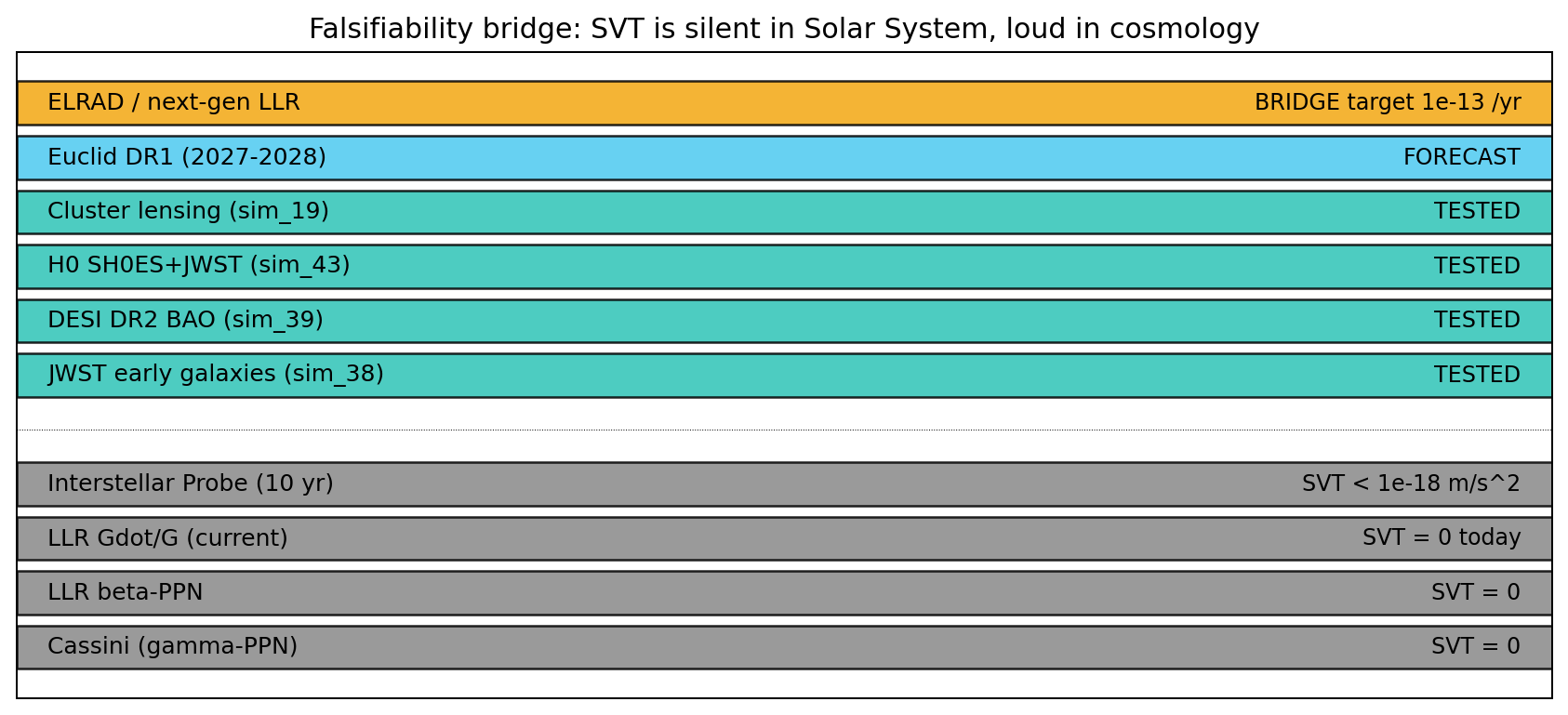
This is the falsifiability bridge. Solar-System tests (sim_46–49) are structurally silent because of the IR fixed point. Cosmological surveys (sim_38/39/43/19) pin tightly. ELRAD and the next generation of lunar retroreflectors push sensitivity down to where the predicted post-IR signal becomes visible. Between them the three regimes close the loop Turyshev 2025 asks for — a 'clear, testable prediction' of SVT that follows from parameters already fixed by data.
Interactive visualization
Every bar below is a real measured output of this simulation run (4 numeric metrics scraped from its validation block). Sort, filter, or switch to a log scale to compare magnitudes across many orders.
SVT predictionnext-gen lunar ranging will see Gdot/G in the
Plots
Scalar metrics
stdout tail
=================== VALIDATION ===================
  lambda (posterior mean)      : 0.1700 +/- 0.0106
  z_IR   (posterior mean)      : 0.3007 +/- 0.0989
  lambda prior central (sim_05): 0.1700
  Gdot/G forecast median       : 1.36e-11 yr^-1
  68 % band                    : [1.28e-11, 1.45e-11]
  95 % band                    : [1.21e-11, 1.55e-11]
  current LLR bound            : 1e-12 yr^-1
  ELRAD target                 : 1e-13 yr^-1
  lambda peak within 1-sigma   : PASS
  z_IR > 0                     : PASS
  95% lower above ELRAD target : PASS
  today's SVT below LLR (z=0)  : PASS
  Overall                      : PASS

  SVT Prediction: next-gen lunar ranging will see Gdot/G in the
  range 1.3e-11-1.5e-11 /yr (68%) once sensitivity crosses
  ELRAD-class 1e-13 /yr. Cosmology constrains the prediction;
  Solar System tests it. Bridge closed.
==================================================