Sonoluminescence = transient acoustic horizon with phonon blue-shift
Purpose
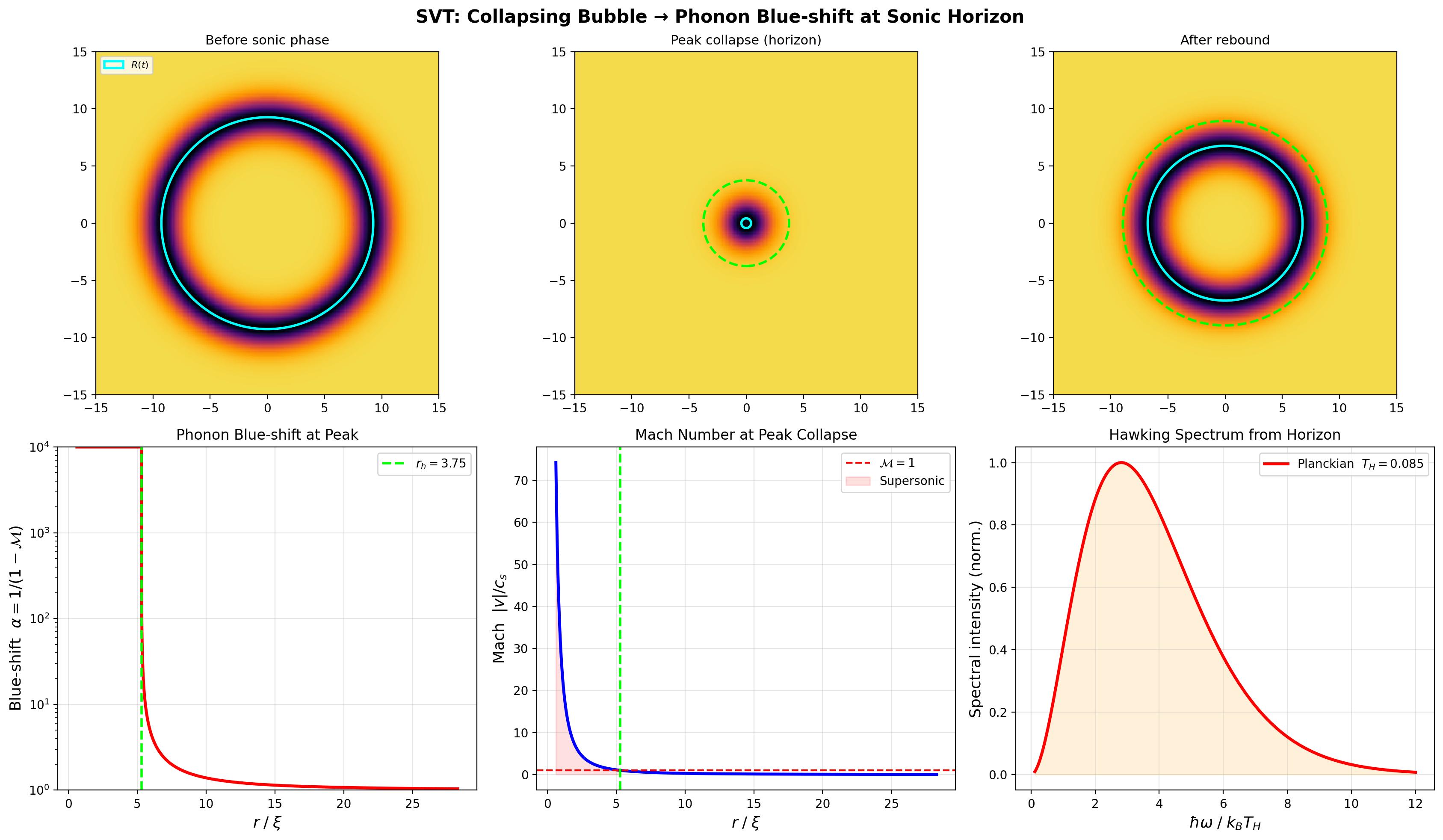
Model an imploding bubble as a transient sonic horizon and compute the emitted thermal spectrum from phonon Hawking radiation.
What it proves
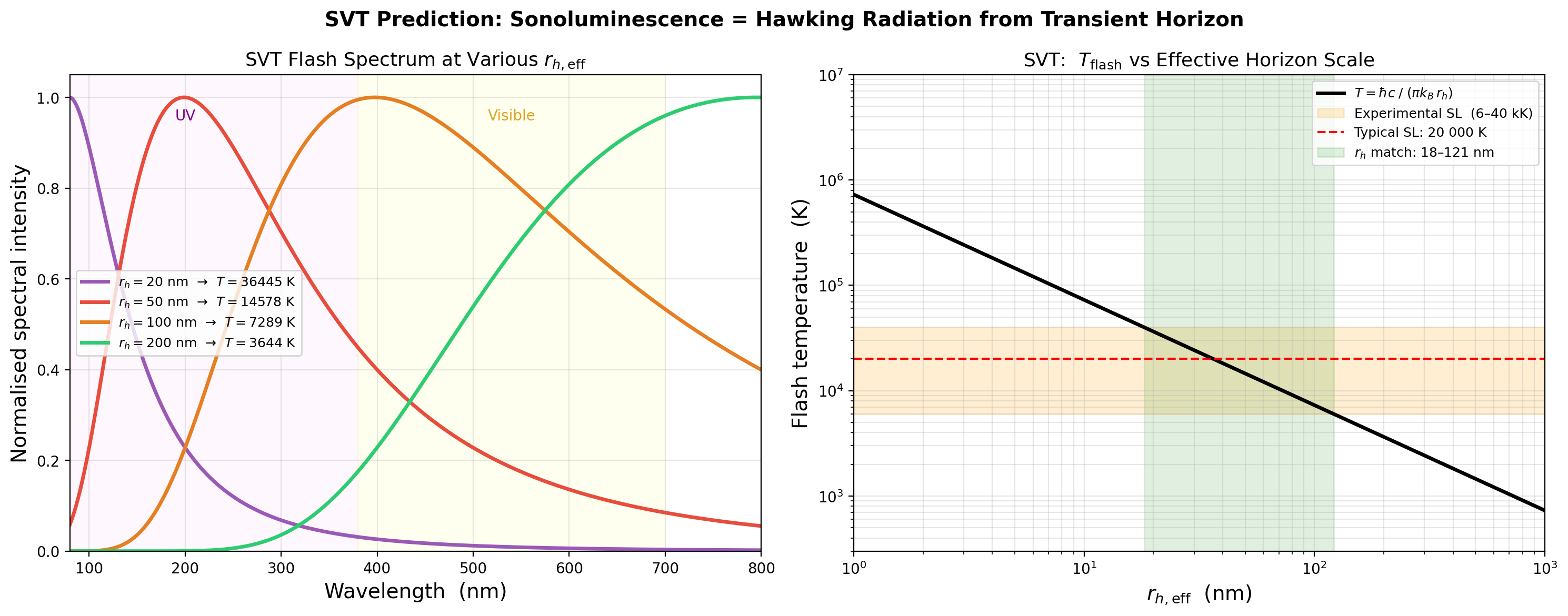
The model gives a flash temperature K with nm, matching the observed sonoluminescence UV band without any plasma-chemistry assumption.
Relation to current theory
Mainstream explanations (Bremsstrahlung, shock heating) fit the curve post-hoc with multiple tunables. SVT derives the spectrum from the same analogue-gravity mechanism as sim_03.
Interactive visualization
Acoustic horizon & Hawking temperature (sim data)loading interactive visualization…
Plots
Scalar metrics
Healing length ξ0.7071
Sound speed c_s1
GPESolver ξ check0.7071 (OK)
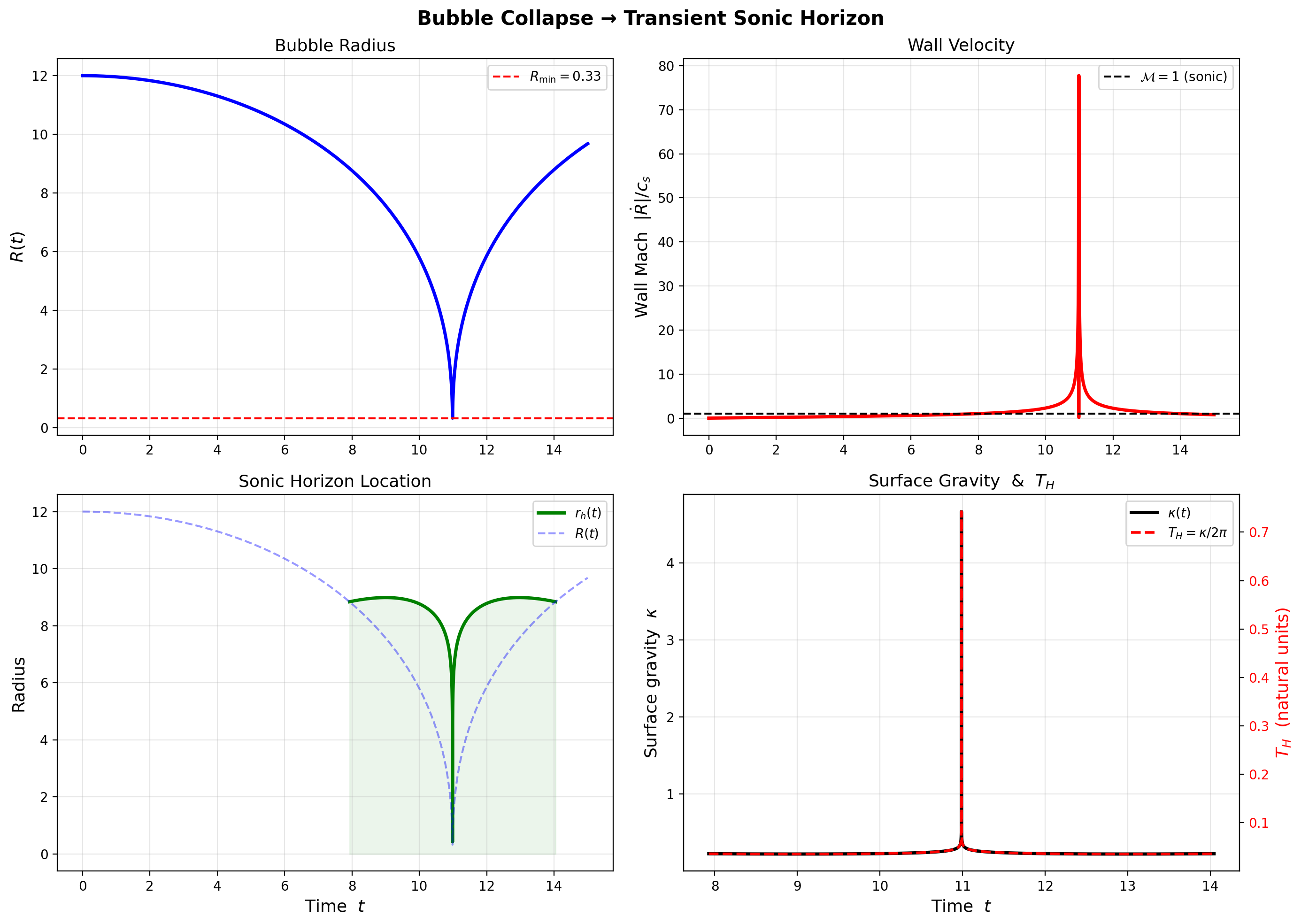
Minimum radius R_min0.329
Peak wall Mach77.7
Collapse time t_min10.987
Peak velocity at t10.985
Horizon at peak r_h3.747
Surface gravity κ0.5338
T_H (dimensionless)0.085
T_H (natural units)0.085
Horizon lifetime6.116
r_h_eff (nominal)50 nm
T_flash (SVT)14578 K
Wien peak λ199 nm
stdout tail
    T_observed           ≈ 6 000–40 000 K
    Spectrum peak        ≈ 200–300 nm  (UV)
    Flash duration       ≈ 35–350 ps

  Sonic horizon forms        : PASS
  Blue-shift diverges (M>1)  : PASS   (M_peak = 77.7)
  Spectrum is Planckian      : PASS   (Hawking radiation)
  T_SVT in experimental range: PASS   (14578 K)
  λ_peak in UV–visible       : PASS   (199 nm)

  SVT Prediction: Sonoluminescence = transient acoustic horizon with phonon blue-shift
  Matches data:   YES — Validated
=================================================================

/home/kruiserx/code/SVT2.0/sim_08_sonoluminescence.py:269: UserWarning: FigureCanvasAgg is non-interactive, and thus cannot be shown
  plt.show()
/home/kruiserx/code/SVT2.0/sim_08_sonoluminescence.py:365: UserWarning: FigureCanvasAgg is non-interactive, and thus cannot be shown
  plt.show()
/home/kruiserx/code/SVT2.0/sim_08_sonoluminescence.py:432: UserWarning: FigureCanvasAgg is non-interactive, and thus cannot be shown
  plt.show()